
Thursday, October 25, 2012
Fermilab 2012
The operation of the Tevatron, the world’s second largest particle accelerator, at Fermilab was a coalition of efforts by numerous physics, material scientists, and engineers from diverse backgrounds ranging from particle physics, to polymer science and superconductivity. In our trip to the accelerator, measuring 1 kilometer in diameter, the AVS group had a chance visit many of the sites along its perimeter, while talking the primary actors involved in continuing the legacy left by the discovery of the bottom Omega baryon. Amongst the various sites seen, the group had an opportunity to tour within the DZero detector!

Friday, April 20, 2012
James Coleman Seminar
 Semiconductor quantum dot lasers have been extensively studied for applications in future lightwave telecommunications systems. Prof. Coleman described the growth, processing and characteristics of quantum dot and nanostructure lasers that exhibit interesting and potentially important effects arising from reduction of the active medium to the quantum regime (<50 nm) in all three dimensions. The motivation for quantum dots in lasers was outlined along with methods for forming self-assembled and patterned quantum dots. The resultant laser characteristics was presented. Prof. Coleman introduced a novel inverted quantum dot structure or nanopore laser, containing three dimensional quantization formed from an engineered periodicity.

Wednesday, April 18, 2012
Vacuum Workshop 2012

Two-day vacuum workshop on April 17th and 18th 2012 from 11:00-1:00 pm in MRL 280!
Do you work with vacuum systems?
PLD? MBE? CVD? ALD? Sputtering?
Ever wonder how to build a vacuum chamber?
Ever wonder why your base pressure is too high?
Ever wonder what materials are vacuum compatible?
Ever wonder how to use a leak detector?
These are some of the questions we will be addressing at our two day vacuum workshop on April 17th and 18th from 11:00-1:00 pm in MRL 280!
The full list of topics are: gas and surface physics, vacuum technology, industry standards, component design and fabrication, system operation and safety.
Lunch will be provided.
To attend pre-register with the form at the bottom of this page. (Registration is now closed.)
Hosted by UIUC AVS Student Chapter. Presented by A&N Coorporation (http://www.ancorp.com/).
For more information, contact Frank Bergschneider at Fberg@ancorp.com or the UIUC AVS Student Chapter at illinoisavs@gmail.com
Friday, March 9, 2012
Engineering Open House 2012

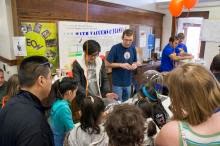
At Engineering Open House, the AVS Student Chapter held exhibitions to introduce kids and adults to the fun of vacuum science. One exhibition involved the effects of atmospheric pressure on everyday objects, or more specifically: what would happen to peeps and shaving cream in space! Another bewildered even adults by freezing water after making it boil in a vacuum! Be sure to see our videos: peep in a vacuum, shaving cream in a vacuum, boiling water that freezes in a vacuum, balloon in vacuum, and candle in a vacuum!


Saturday, February 11, 2012
Anthony Leggett Seminar


Friday, October 28, 2011
Milan Mirksich Seminar

The necessity to identify the plethora of still unknown biomarkers and reaction pathways required to individualize therapeutics to patient-specific phenotypes or to mass distribute cost effective microfluidic assaying devices to developing counties is pressing. However, the daunting number of unique compounds and reactions playing important roles renders any attempt at progress without high throughput considerations ludicrous.
Prof. Mirksich described an approach for using mass spectrometry to analyze self-assembled monolayers of alkanethiolates on gold. This technique, termed SAMDI MS, can efficiently identify the masses of substituted alkanethiolates in the monolayer and therefore enables the use of monolayers to assay a broad class of enzyme activities — including kinase, protease, methyltransferase and carbohydrate-directed modifications — and for discovering chemical reactions. In the seminar, he described applications for high throughput experiments, including the construction of peptide arrays and their use to profile the deacetylase and acetyl transferase family of enzymes, and to explore non-intuitive ways in which networks of enzymes can control protein acetylation.
Friday, October 7, 2011
Dmitri Talapin Seminar

The necessity to identify the plethora of still unknown biomarkers and reaction pathways required to individualize therapeutics to patient-specific phenotypes or to mass distribute cost effective microfluidic assaying devices to developing counties is pressing. However, the daunting number of unique compounds and reactions playing important roles renders any attempt at progress without high throughput considerations ludicrous.
Prof. Mirksich described an approach for using mass spectrometry to analyze self-assembled monolayers of alkanethiolates on gold. This technique, termed SAMDI MS, can efficiently identify the masses of substituted alkanethiolates in the monolayer and therefore enables the use of monolayers to assay a broad class of enzyme activities — including kinase, protease, methyltransferase and carbohydrate-directed modifications — and for discovering chemical reactions. In the seminar, he described applications for high throughput experiments, including the construction of peptide arrays and their use to profile the deacetylase and acetyl transferase family of enzymes, and to explore non-intuitive ways in which networks of enzymes can control protein acetylation.
Subscribe to:
Posts (Atom)